Cork from John Jacob Astor's lifebelt
It is well known that some lifebelts were cut up aboard the body-recovery ship Mackay-Bennett. Some parts were even used as pillows for the Titanic victims' heads. Upon arrival in Halifax, the lifebelt worn by John Jacob Astor, the wealthiest passenger aboard, was cut up into approximately forty pieces and given to the undertakers who came to Halifax to assist with the victims' bodies.
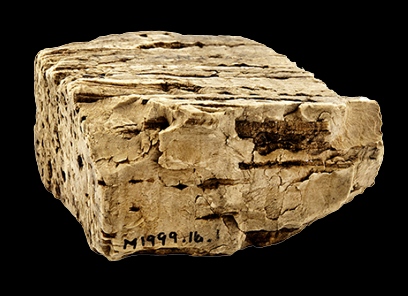
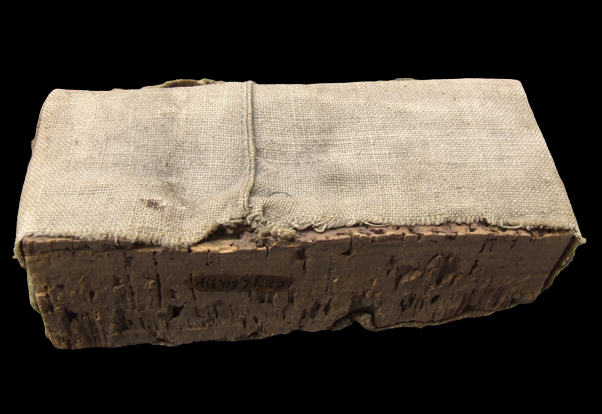
The piece on the left was kept by undertaker Thaddeus Stephens. Who owned the piece at the right is unknown.
Photo by Lynn Marie Richard, Maritime Museum of the Atlantic, Halifax.
Reading through the newspaper archives it can be seen that Astor’s lifebelt was not the only one being cut up. An article in the Barre Daily Times of Saturday, April 20th, 1912, stated that the crew of Carpathia “busied themselves for three hours yesterday cutting up life preservers that were brought aboard. These will be sold as souvenirs.” This means there might be a lot of pieces with their whereabouts unknown.
MORE PIECES OF ASTOR's LIFEBELT?
It seems at first that the pieces in the article are different from those on display now in Halifax, as they seem to be from a different undertaker. But they seem to be indeed from the same source originally. On the display it is said, that they were from an undertaker by the name of "Thad Stevens" from Pictou. Thad Harry Stevens was from Pictou, N.S. who was a carpenter at the time, who made his apprenticeship from 1909 onward at a undertaker. He seems to have been at the dock when the Mackay-Bennett arrived. He helped at the Mayflower Morgue. He operated his own funeral home in Hampton from 1923 to 1951. He was born in 1891. He married in 1910 Josephine Heighton (born 1885), who was the younger sister of Frederick McLean Heighton (born 1874). Frederick had lived since 1894 in the United States, married 1898 in Illinois and moved to Nantucket County with his family between 1905 and 1910. He lived there at least until 1940 and died in 1950 in Maine. The article from 1937 fits perfect into his place of living. The piece of cork mentioned was therefore not from his brother, but from his brother-in-law, Thad Harry Stevens. I would guess that this is not the same piece as the one in Halifax. Thad Stevens died in 1987 in Saint John, New Brunswick. The link between the Halifax piece, donated by a Mary I. Brown in memory of her father James W. Brown is not clear to me. It is clearly linked to Thad Stevens, but how he was related to James W. Brown is not clear to me. I found some candidates, also linked to Pictou, but not sure if any of them is the right one. It was also suggested they were friends which could well be.
Of course in general one would have to doubt that it is from Astor's lifebelt. As these pieces were kept from someone that was not involved in the recovery and the lifebelts were removed on the Mackay-Bennett. It seems that Thad Stevens could have been working on the body of Astor, and possibly would have had access to lifebelts as well. But in a portrait about him in 1985 it is stated: "A Charlottetown undertaker kept the lifejacket on which Astor's head had lain. Stevens said the jacket was later displayed - draped in black - in the funeral home window." It is very understandable that their most famous "client" attracted them, but I doubt that lifebelts could be attributed to individuals after the recovery of bodies. Of course we know transitions of stories from like "This is one of the lifebelts as it was also worn by Astor" to "this was worn by Astor".

Nantucket Inquirer and Mirror, 24 April 1937
Maak jouw eigen website met JouwWeb